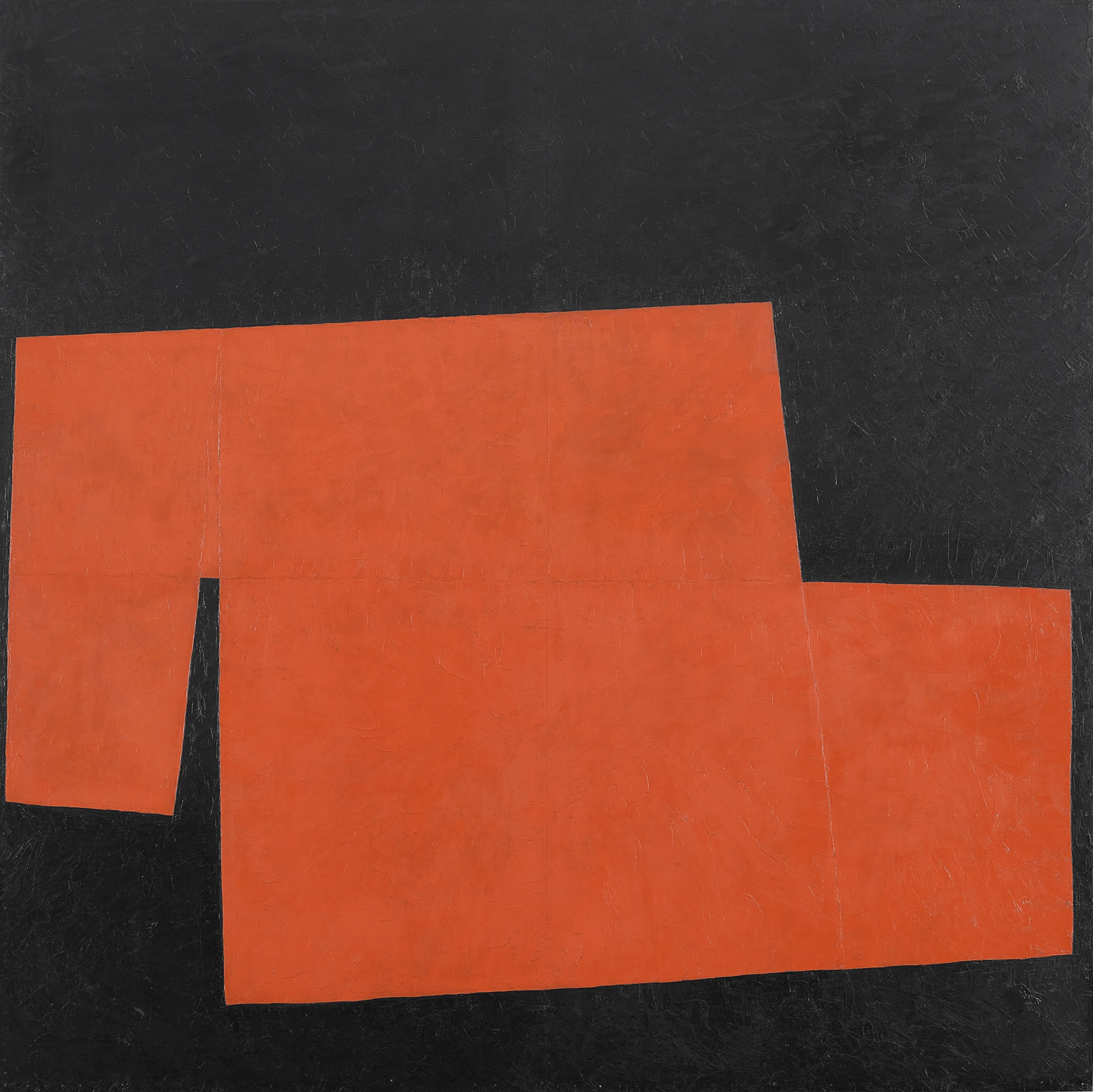

Takeo Yamaguchi trained in Tokyo and Paris, where Cubism’s push toward flat, unmodulated color stuck with him more than anything else in early European modernism. He found his mature style back in Tokyo in the 1950s by combining two rival postwar movements: Art Informel’s thick, worked surfaces and monochrome painting’s reduction to a single color. Yamaguchi often mixed his oil paint with glue, building up a dense, leathery skin of pigment rather than a thin, even coat — so even a single flat color shape carries real physical texture up close.
That combination is the real lesson in a piece like this one: a whole composition can rest on just one dominant color shape and the ground it sits against. Here, a single saturated orange plane, its edges cut at sharp, uneven angles, pushes against a dark, textured field behind it — and that’s the entire picture. There’s no supporting cast of smaller shapes or secondary colors to lean on. Notice how much tension comes from the diagonal cut of that one edge alone, and how the surface texture keeps a “flat” color from ever feeling static or empty.


