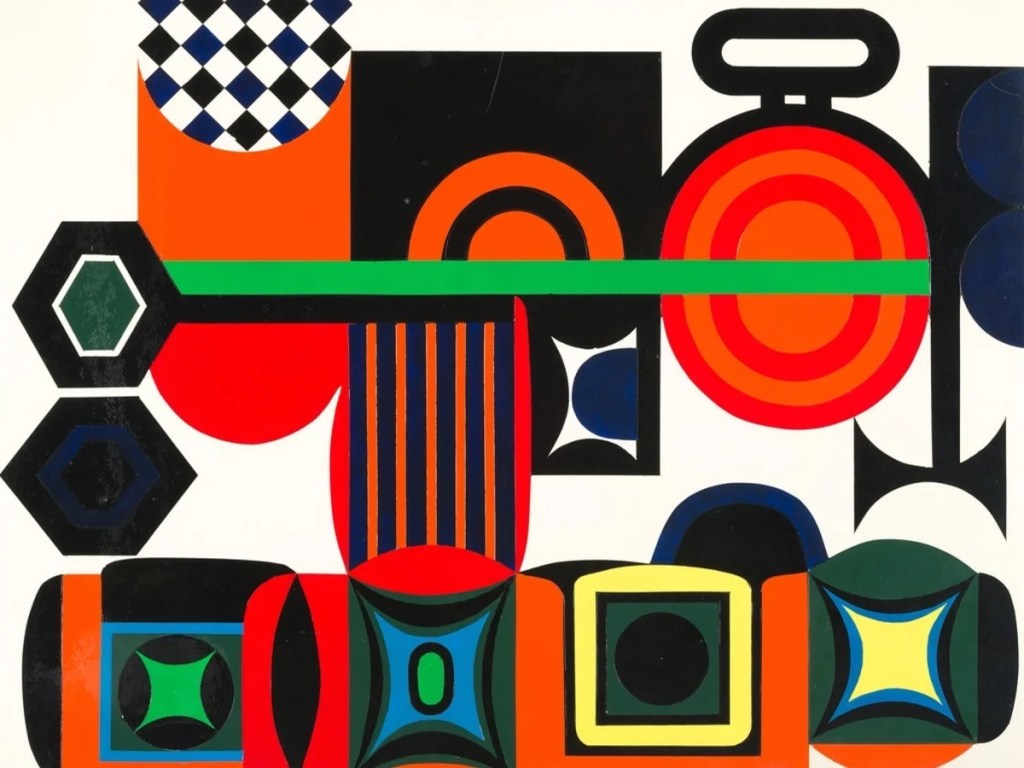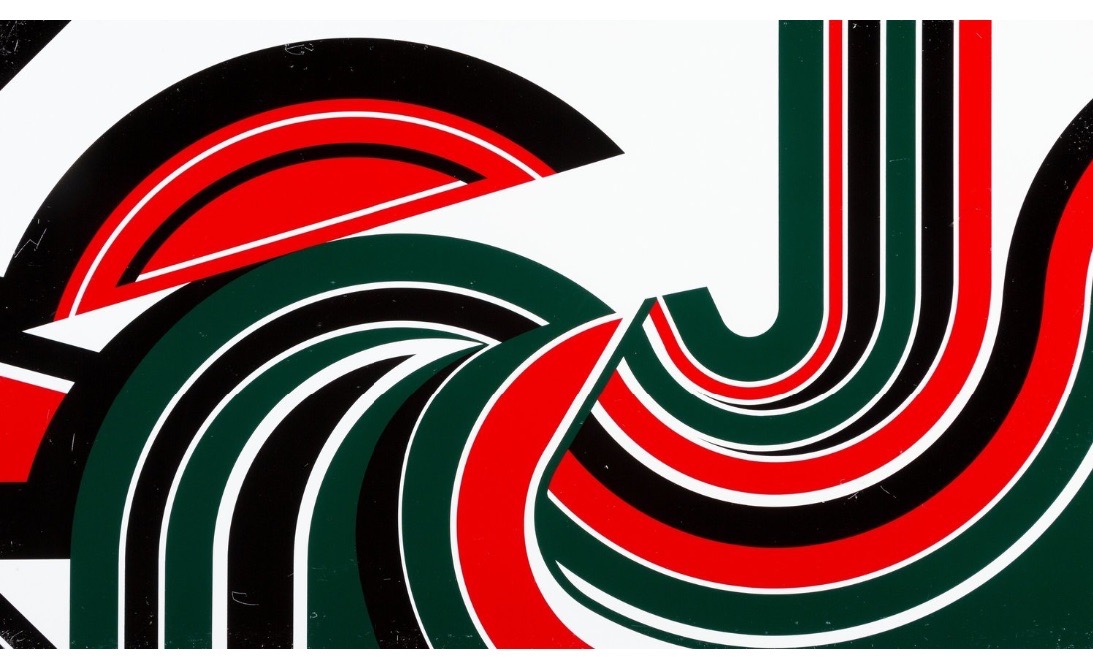

Jean Dewasne carried color blocking into industrial territory. Working in postwar Paris, he abandoned traditional paint for glycerophthalic lacquer — the same hard, glossy enamel used on cars and appliances — applied to wood and metal panels in flat, unmodulated fields. His palette stayed famously restrained: red, green, black, white, and only rarely yellow, repeated across nearly every canvas. (He later talked the architects of the Centre Pompidou into painting its exposed pipes in these same colors.) Like Stuart Davis, Dewasne builds compositions from interlocking planes of solid color rather than blended tone — but where Davis’s shapes stay rectilinear, Dewasne’s curve and spiral.
That’s the added lesson here: color blocking doesn’t have to sit still. By bending the edges of his flat color shapes into sweeping arcs and coils, Dewasne makes a composition built entirely of solid hues feel like it’s spinning or unraveling — motion suggested purely through the shape and direction of a color block’s boundary, with no gradient, shading, or blur required. It’s a reminder that “flat” color and “static” composition aren’t the same thing; how a color shape is cut can carry as much energy as the color itself.