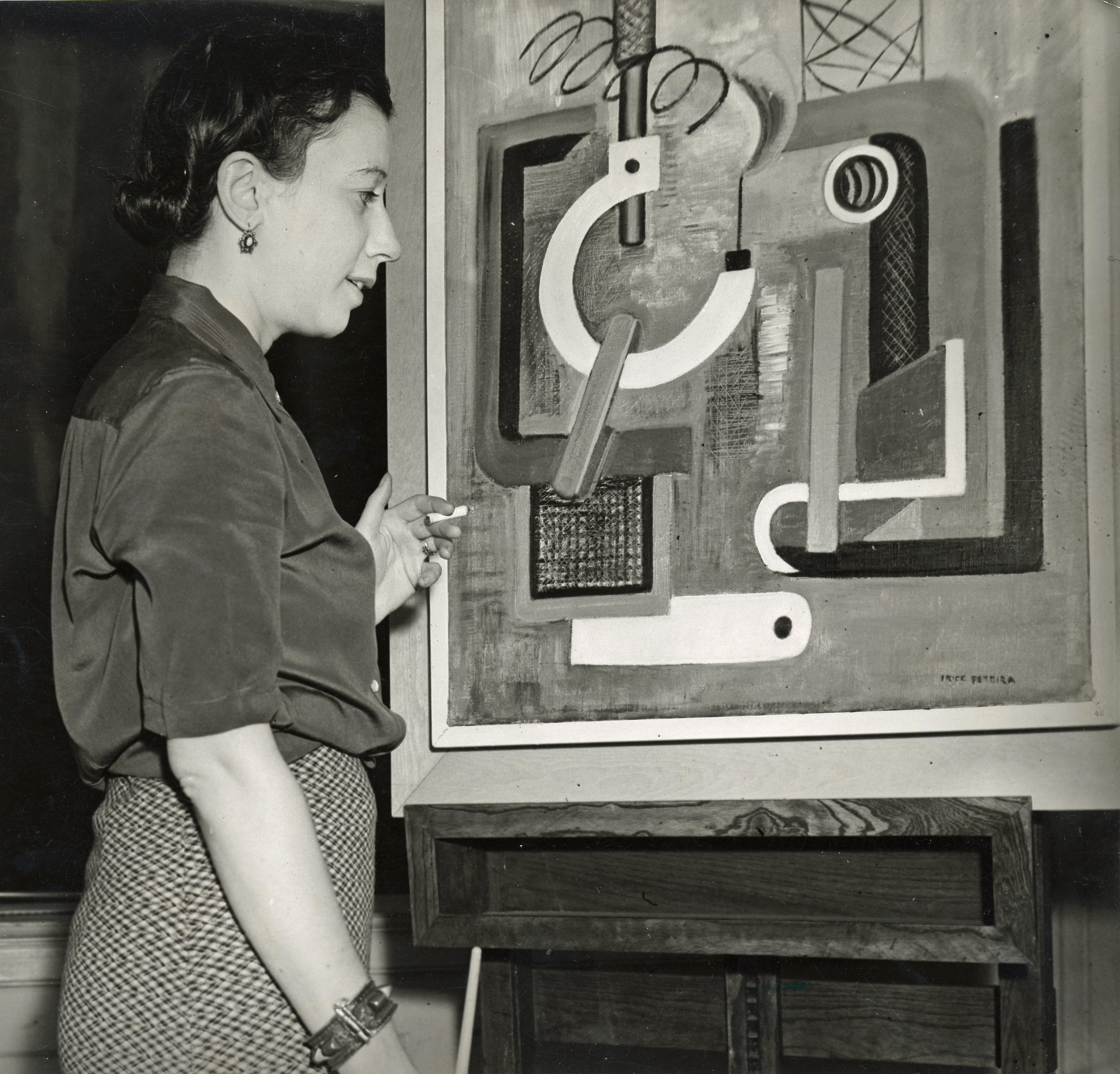

I. Rice Pereira (Irene Rice Pereira) started out painting industrial imagery — ship’s ventilators, gears, hinges, levers — before pushing into pure geometric abstraction in the late 1930s, the shift visible in the machine-composition painting behind her in this photograph. As she moved further into abstraction, she became known for interlocking her compositions from a tight vocabulary of shapes: rectangles, triangles, quadrangles, arcs. Rather than building those blocks from flat color the way Stuart Davis or Harold Krisel did, Pereira often worked in value and pattern — dense cross-hatching, layered line work, and blocks of black, white, and gray locked together with the same rigor other artists in this series apply to hue.
Pereira’s work is a reminder that blocking doesn’t require color at all: the same principles of interlocking flat shapes, clear boundaries, and figure-ground clarity hold when the “color” is really a value or a texture. Look at how her overlapping rectangles and triangles stay legible even in dense cross-hatched fields — that’s achieved through contrast in tone and pattern density, not hue. It’s color blocking’s underlying logic stripped down to black, white, and gray, showing that what really matters is the shape and its edge, not the palette used to fill it.


