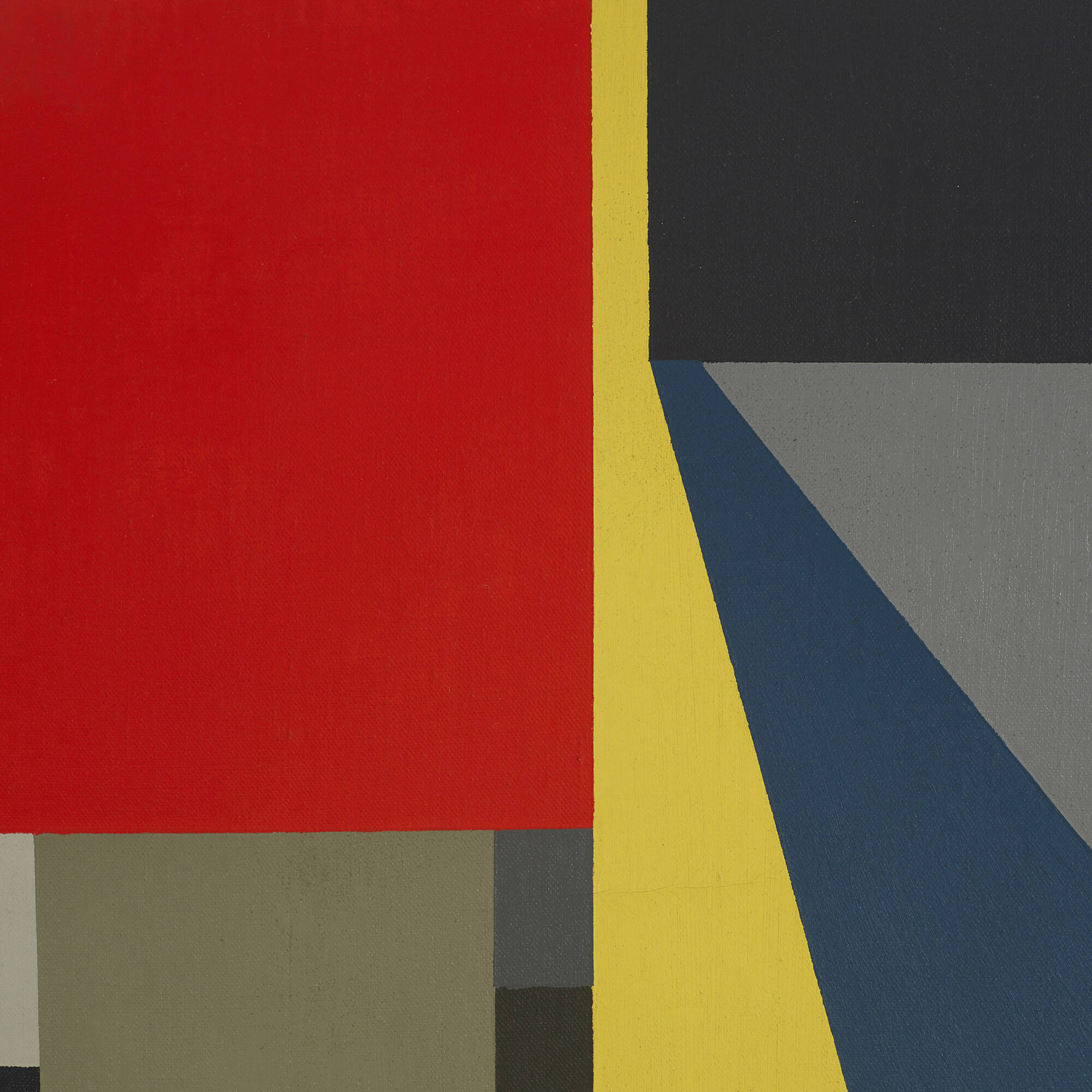

Harold Krisel came to abstraction early and personally: as a teenager in 1930s New York, he studied with Harry Holtzman, the artist who brought Piet Mondrian to the US to escape World War II — and meeting Mondrian pushed Krisel toward reducing his compositions to flat shape and color. He went on to train as an architect at Chicago’s New Bauhaus and the Illinois Institute of Technology, working professionally at Skidmore, Owings and Merrill before teaching architecture and eventually working full-time as an artist. That architectural training shows: his compositions read like plans, built from a handful of essential shapes — a diamond, a rectangle, a sliver — each locked into place as a single flat color.
Krisel’s color blocking is a lesson in economy: rather than filling a composition with many colored shapes, he asks how few shapes, and how few colors, can still create a balanced arrangement. Notice how the different sizes and proportions of his shapes — a large diamond balanced against a cluster of narrow vertical bars — do the work that gradients or texture might do elsewhere, creating visual weight and hierarchy through scale and placement rather than shading. It’s color blocking distilled to its simplest vocabulary.


