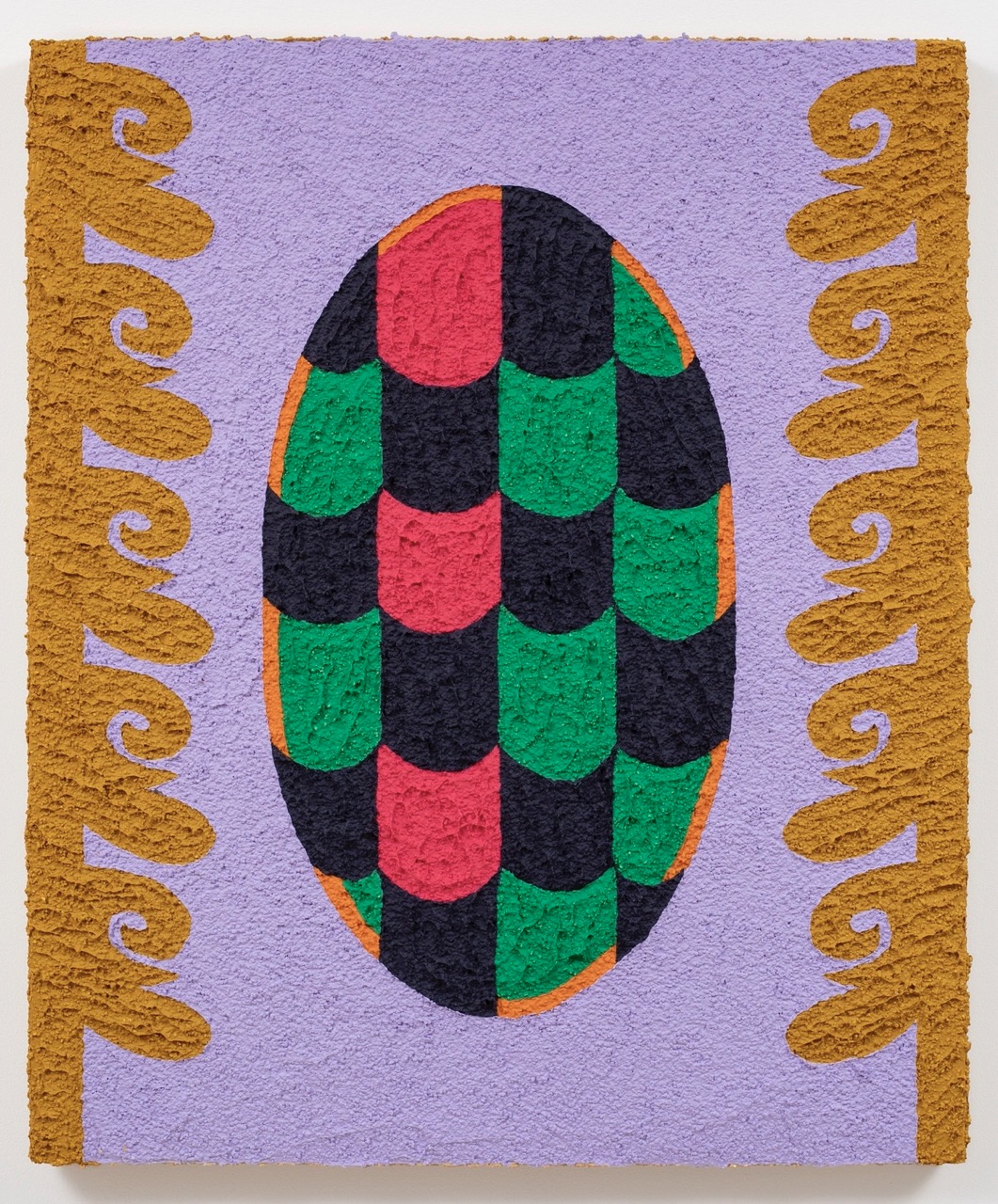

Like Stuart Davis, Carlos Rosales-Silva builds his paintings from flat, interlocking blocks of solid color — but he trades Davis’s Cubist-inflected still lifes for the visual language of the US-Mexico border: piñatas, cascarones, roadside signage, hand-painted storefronts, the stucco and cinderblock walls of the American Southwest. Every shape in a Rosales-Silva painting carries one flat, unblended hue, locked edge to edge against its neighbors, with no gradient or shading anywhere. What makes his color blocking distinct is texture: he mixes sand, crushed stone, and glass bead directly into his acrylic, so each color block also carries a specific weight and grain, more like a painted wall than a smooth canvas.
That’s the added lesson here: color blocking isn’t only about hue relationships, it’s also about how a shape’s surface quality changes how a flat color reads next to its neighbors, adding another layer of contrast and figure-ground clarity. Rosales-Silva, who studied at the School of Visual Arts and has shown from Los Angeles to Mexico City, makes the case that color blocking isn’t a mid-century relic — it’s alive today in vernacular painting traditions. You can see more of his work on his website.


