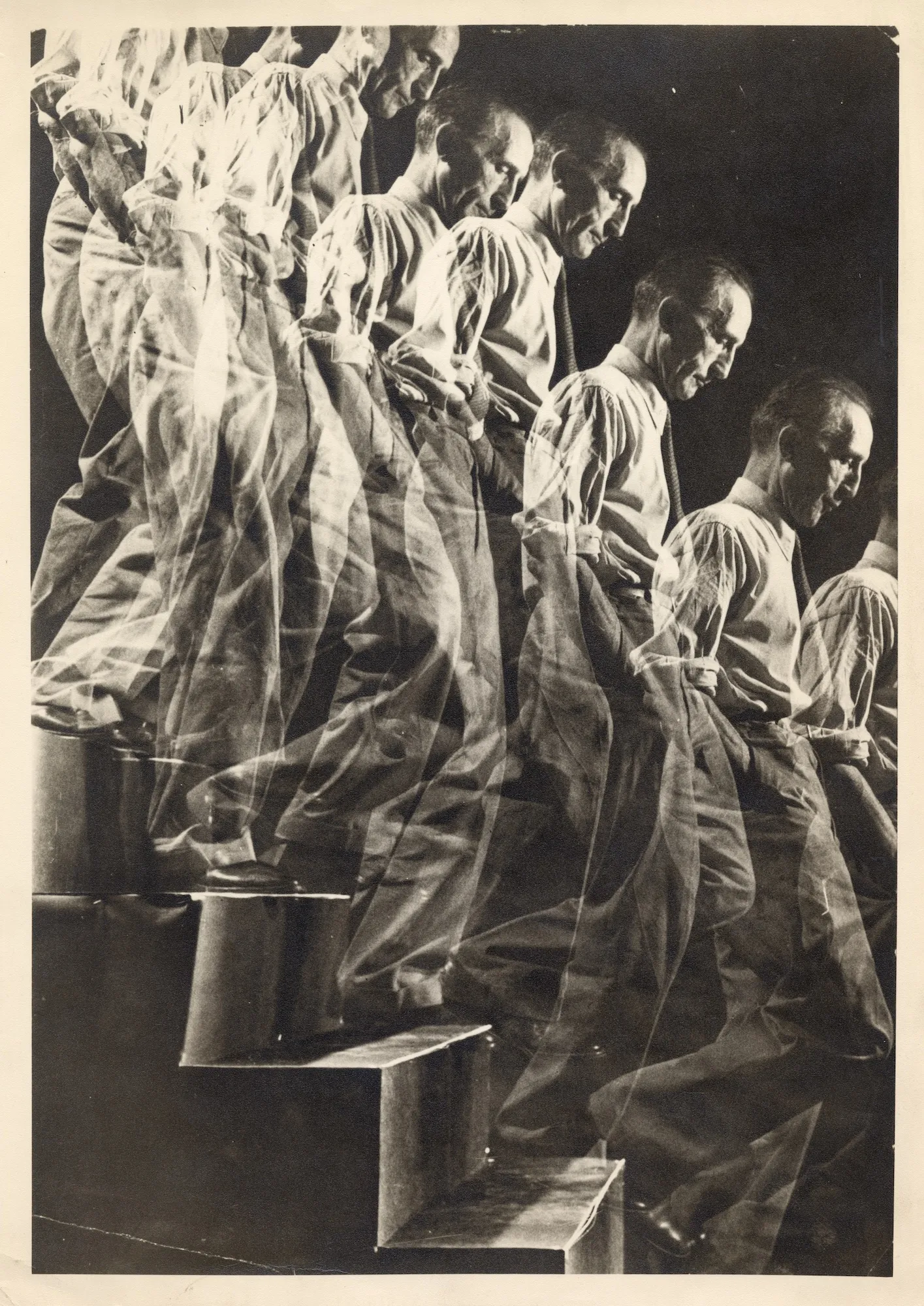
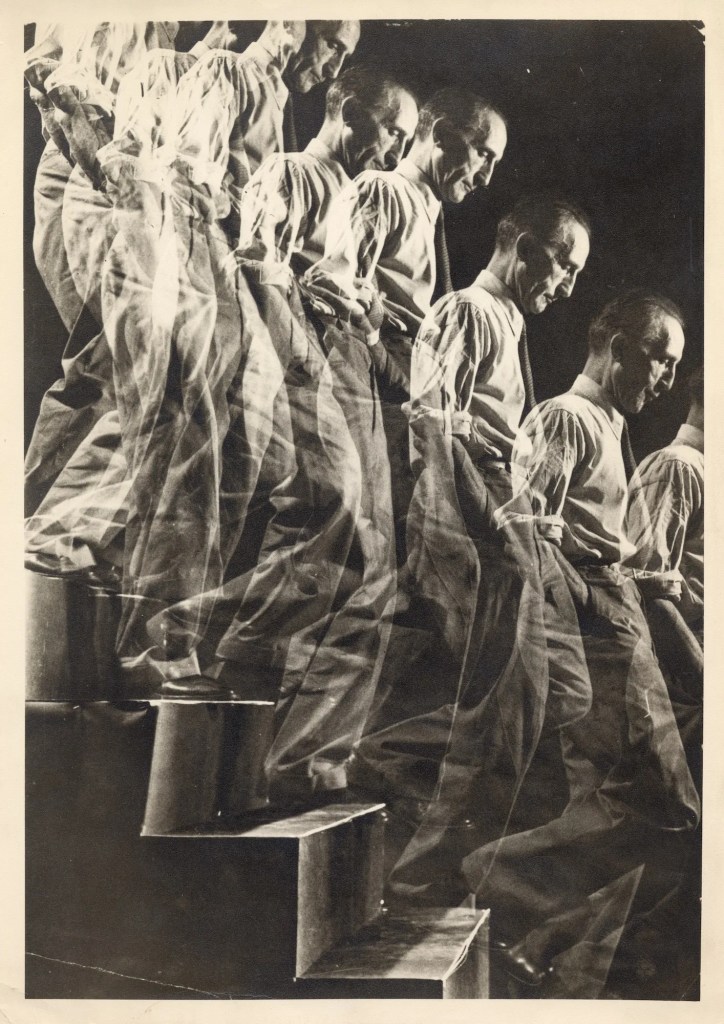
Marcel Duchamp’s Nude Descending a Staircase, No. 2 (1912) tackles the same problem as Balla’s dog, but breaks the figure down structurally rather than just repeating it: a descending body is sliced into a stack of overlapping, semi-transparent brown-and-tan planes, each one a slightly later position layered directly on top of the last, so an entire sequence of movement reads simultaneously in one image. Like Balla, Duchamp was working directly off Marey and Muybridge’s chronophotography, but where Balla kept the dog’s legs as legs, Duchamp abstracted the body into a rhythm of intersecting facets — motion rendered as a structural diagram rather than a recognizable figure. He carried the same idea into literal machinery later on: his 1924 Rotary Demisphere used a spinning spiral disc that, once set turning, tricks the eye into seeing an illusion of depth advancing and receding — implied movement engineered directly into the object rather than painted onto it.


