
Wucius Wong was a Hong Kong-born designer, painter, and educator whose book Principles of Two-Dimensional Design, published in 1972, became one of the quiet foundations of design education in the second half of the twentieth century. Where many design texts of the era were loosely organized, Wong was systematic — almost mathematical — in his approach to visual form. He believed the underlying structures of design could be described, categorized, and taught, and his books remain useful precisely because they make the invisible logic of composition legible.
One of Wong’s most elegant contributions is his use of numbered grids to map gradation sequences onto spatial compositions. Assign each cell in a grid a number corresponding to a step in a visual sequence — a shape morphing from one form to another — and the number map becomes a compositional logic. The resulting image isn’t arbitrary; it’s the direct consequence of a spatial decision made before a single shape is drawn. Different grid patterns — diagonal bands, concentric rings, four-quadrant mirrors, radial diamonds — produce entirely different visual outcomes from the same underlying sequence.
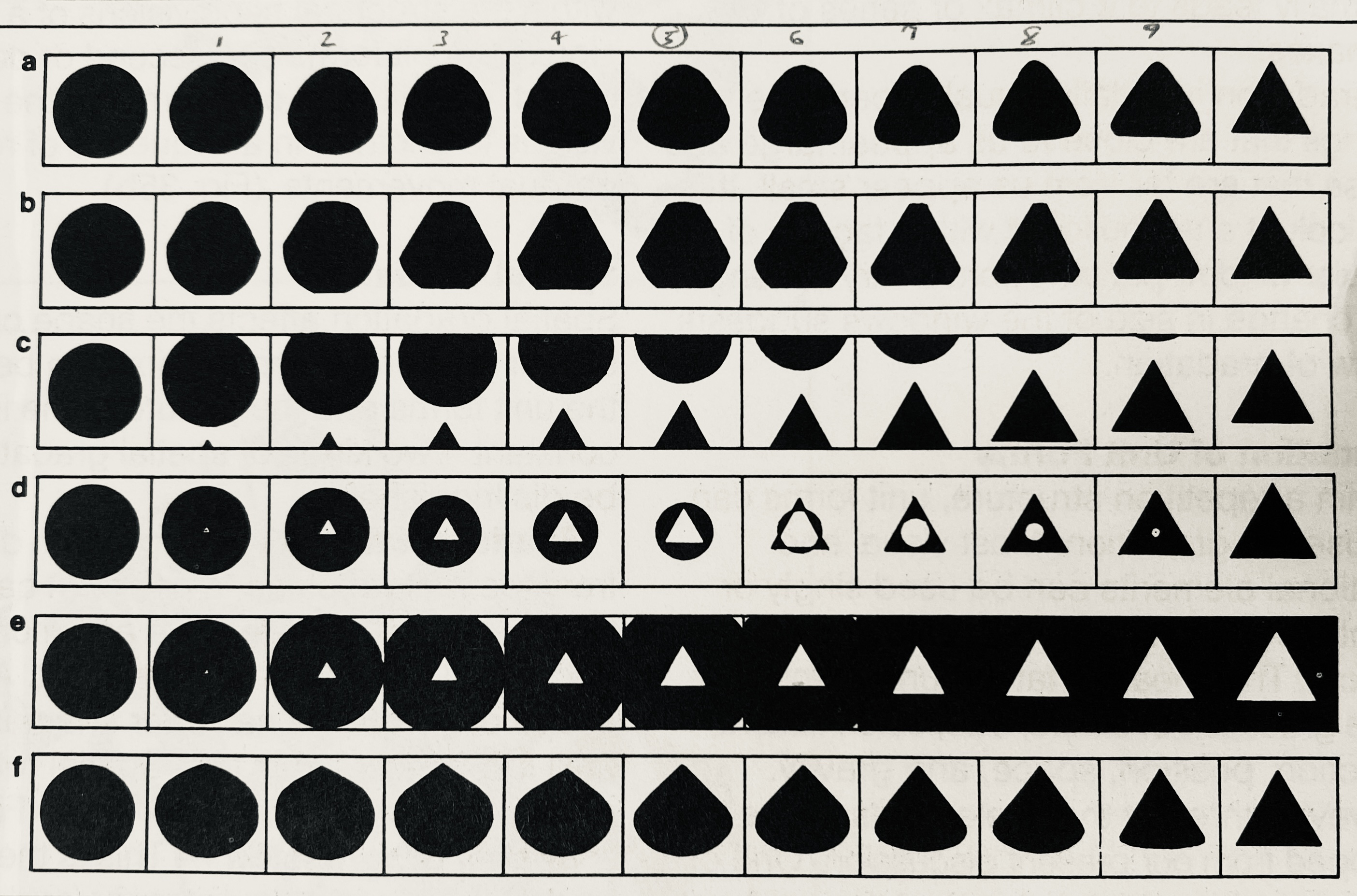
When a shape sequence moves from a black-dominant form to a white-dominant one, the grid orchestrates zones where figure and ground actively trade places. The ability to achieve genuine figure-ground reversal — where neither black nor white dominates, where both press forward with equal insistence — is one of the more difficult things to accomplish in two-dimensional design. Wong’s grid method gives students a concrete, structured path toward it.
It’s worth noting that in Wong’s own morph sequences, the shape gradation and the figure-ground reversal are kept as separate problems — most of his rows show a black form morphing on a white ground, with only one sequence (row e) introducing a full ground inversion. This is actually the cleaner pedagogical approach: mastering the shape morph first, then tackling figure-ground as its own challenge. The grids shown here apply that same logic — the morph sequence drives the pattern, and figure-ground tension emerges from the composition itself.

The 11-step sequence above runs from step 0 (left) to step 10 (right), taken from Wong’s book. A triangle morphs into a circle as the figure-ground relationship inverts — white figure on black ground at the start becomes black figure on white ground by the end. The gallery below shows compositions built on 5×09, 10×10, 12×12, and 20×20 grids; each image pairs the finished composition (left) with its numbered step placement grid (right).


