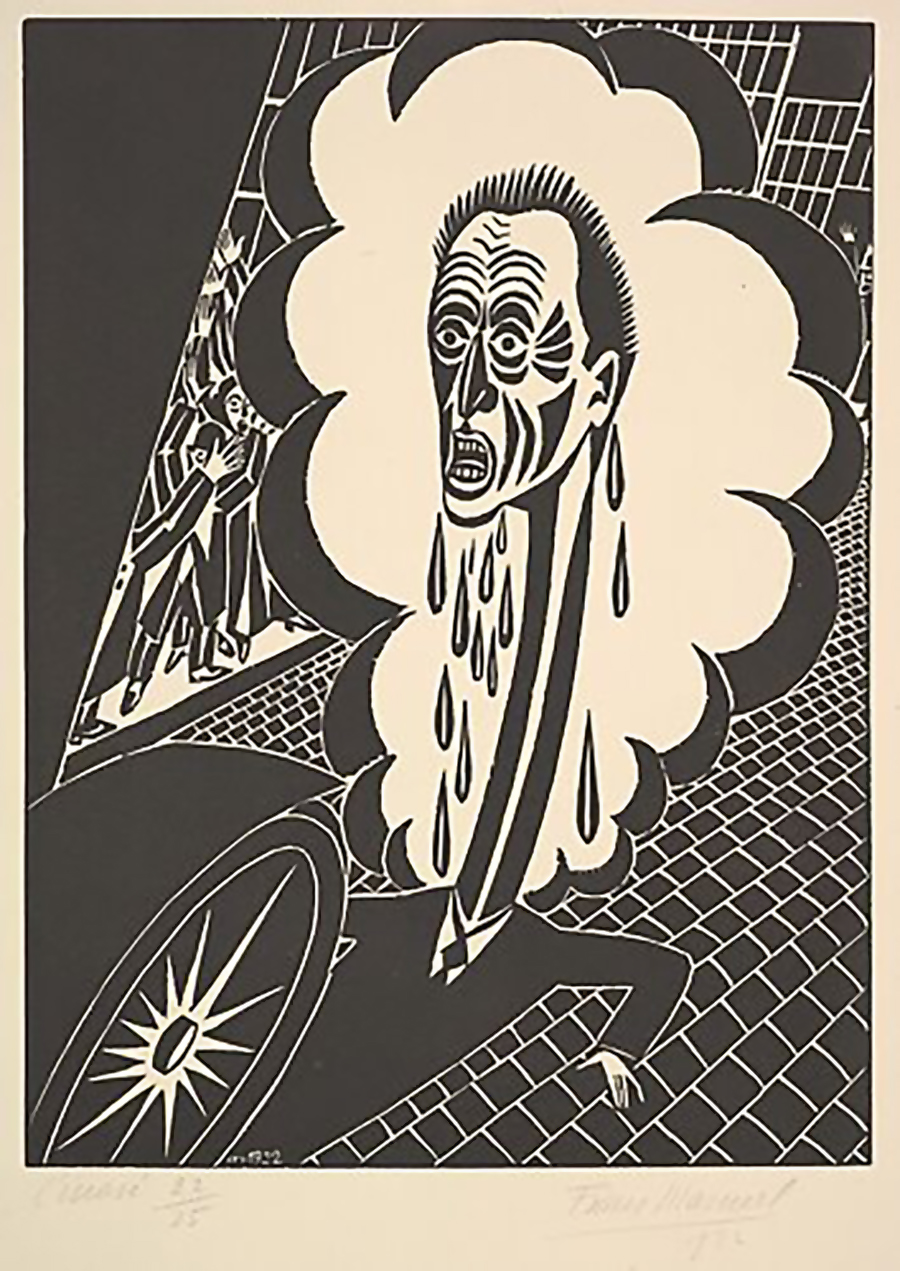
Frans Masereel was a Belgian artist and printmaker who worked primarily in the first half of the twentieth century, producing an enormous body of woodcuts — including wordless novels told entirely in sequential images. His woodcuts are exercises in pure notan: figures carved from solid black, white light breaking through dark architecture, crowds dissolving into shadow. Because the woodcut medium demands that you commit — every cut removes material permanently — Masereel had to think in terms of dark and light as equal forces from the very beginning of each image. The result is work where the black is never simply background and the white is never simply absence. They press against each other on every page.


Where Masereel’s woodcuts feel cinematic and fluid — figures moving through darkness like light through a shutter — Ernst Ludwig Kirchner cuts with a rawer, more agitated hand. Kirchner was a founding member of Die Brücke, the German Expressionist group whose woodcuts were deliberately crude in the best sense: rough-edged, urgent, psychologically charged. His notan is less about elegance and more about pressure — black and white in open conflict rather than graceful interlock. The figure doesn’t emerge from the ground so much as fight its way out of it. Looking at a Kirchner woodcut next to a Masereel, you feel the difference in intent immediately: one is a storyteller, the other is someone trying to get something out of his system.


