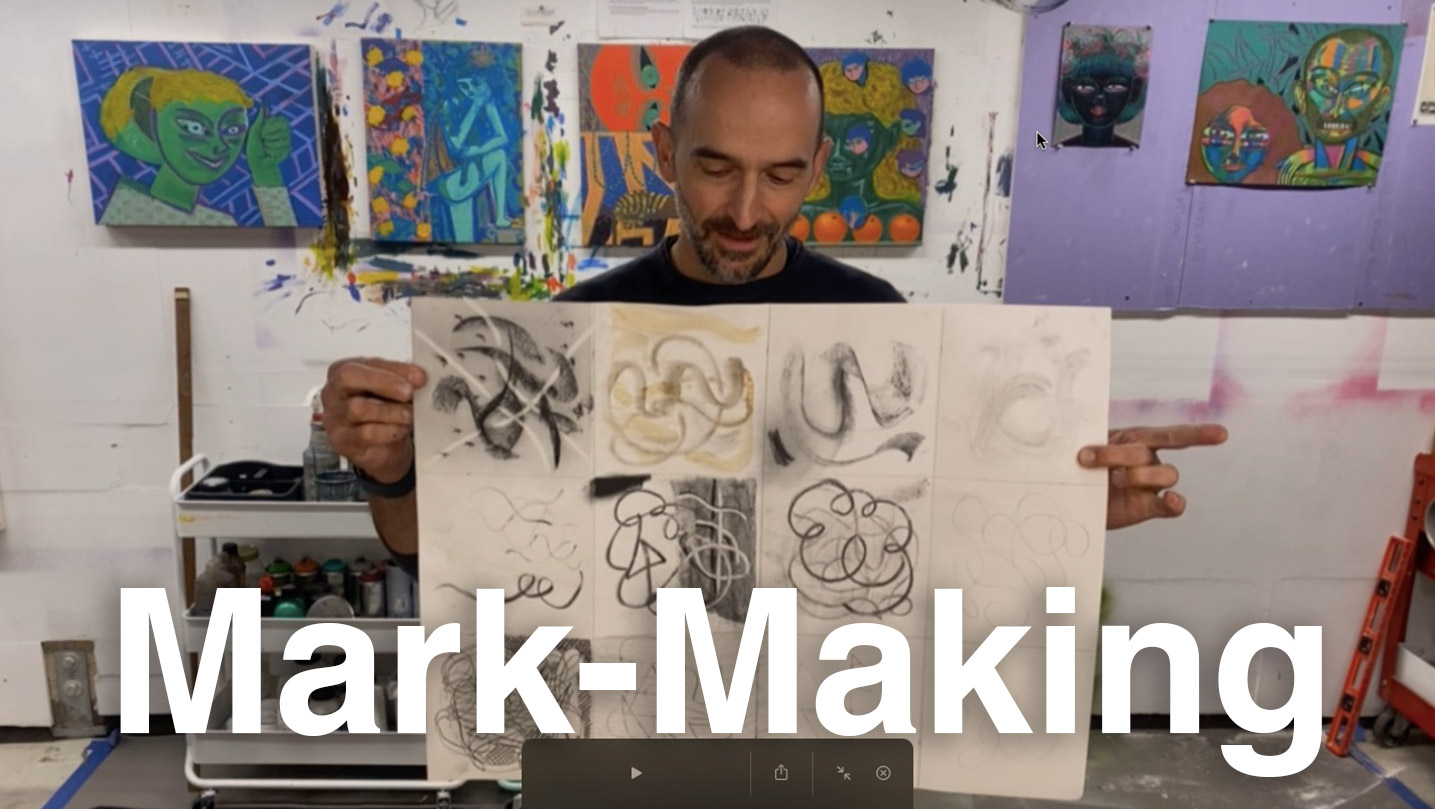
A mark-making chart isn’t about making a good drawing. It’s about detaching your hand from any particular image and just finding out what your materials do. The grid gives you a simple structure — light to dark as you move left to right, thin to thick as you move top to bottom — but within each box, anything goes. The goal is maximum variety: organic lines, geometric lines, stippled lines, broken lines, lines drawn with the side of the pencil, lines drawn with an eraser through a toned ground. Each box is its own small investigation, and no two should look alike.
The other thing the chart teaches you is that your tools aren’t limited to what came in the art supply kit. A makeup brush, a dish sponge, a cosmetic wedge from CVS, a spray bottle, even a cup of coffee — all of it is fair game. Vine charcoal and graphite don’t play well together; compressed charcoal and a blending stump create something that barely looks hand-drawn; wetting vine charcoal changes how it behaves entirely. These are things you want to discover before you’re in the middle of a figure drawing and don’t know what your materials can do. The chart is where you build that knowledge, without any pressure riding on the result.