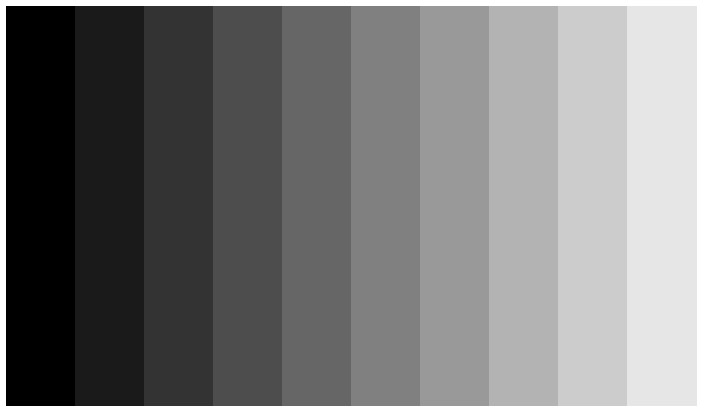

Have you ever noticed that when two slightly different shades of gray sit next to each other, the edge between them seems to glow or vibrate — as if there’s a bright sliver of light on one side and a dark stripe on the other, even though neither is actually there? That’s the Mach band effect, named after the Austrian physicist Ernst Mach, who first described it in 1865.
What you’re seeing isn’t in the image — it’s being generated by your own visual system. The eye and brain are wired to hunt for edges and boundaries, and when they find one, they exaggerate it, making the lighter side look even lighter and the darker side look even darker right at the point of contact. It’s the visual system doing its job almost too well.

This matters for artists because Mach bands appear constantly in the real world — especially on curved surfaces under natural light, where tones shift gradually from light to shadow. That subtle halo of apparent brightness just before a form turns into shadow, or the dark band that seems to deepen right at the edge of a highlight, are both products of this effect. Understanding it can help you see more accurately, and use those perceived edges intentionally in your work rather than being unconsciously misled by them.
The phenomenon is sometimes also called the Chevreul illusion, after the French chemist Michel Eugène Chevreul, whose 19th-century studies of simultaneous contrast showed how colors and tones influence each other across boundaries — ideas that were enormously influential on the Impressionists and Post-Impressionists.


